In the realm of artificial intelligence (AI) and machine learning (ML), a high-quality dataset is the lifeblood of any successful model. For sensitive applications like identity verification and fraud detection, the data requirements are immense, but the challenge of acquiring real-world information is even greater due to privacy concerns and legal regulations.
This has led to the rise of synthetic data generation, with a focus on creating highly realistic synthetic passport datasets.

So, how are these artificial datasets, which are crucial for training the next generation of AI security systems, actually created? The process is a fascinating blend of advanced AI, rule-based systems, and meticulous procedural generation. Unlike simply “photoshopping” a fake ID, creating a useful synthetic passport dataset requires a comprehensive, multi-layered approach to ensure the data is not only visually realistic but also structurally and statistically accurate.
1. The Multi-Component Hybrid Approach
The most effective method for creating a synthetic passport dataset is a hybrid approach that combines different techniques to generate various components of the document. This method ensures that the final product is not just a fake image, but a fully-formed, data-rich document that is indistinguishable from a real one to an AI model. This process can be broken down into a series of core components:
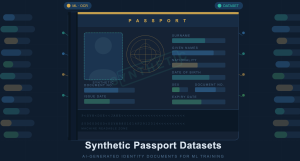
- Template Normalization: The first step involves sourcing or creating a clean, layered template of a real passport’s data page. This is a crucial foundational step. Researchers often start with publicly available layered Photoshop (PSD) files or meticulously reconstruct templates from scratch based on visual references. This “template normalization” process identifies and separates the key layers of the document, such as:
- Static Elements: Fixed text like “Passport,” “Name,” and “Date of Birth.”
- Subject-Specific Fields: Dynamic fields that change for each individual, such as the name, date, and document number.
- Biometric Area: The space for the passport photo and signature.
- Visual Patterns: Complex security features like holograms, watermarks, and security microtext.
- Subject Metadata Generation: This stage focuses on creating all the textual and numerical data for the synthetic identity. This is more than just random text; it’s a rule-based simulation to ensure cultural and structural accuracy.
- Textual Content: Algorithms generate names, birth dates, and issuing authorities from curated, culturally-appropriate lists.
- Machine-Readable Zone (MRZ): The critical two- or three-line code at the bottom of the passport page is generated using open-source libraries that strictly follow the ICAO Document 9303 specification. This ensures that the generated MRZ is not just a jumble of characters but a valid, check-sum-verified code that can be read by OCR systems.
- Biometric Data Generation: The face is one of the most important components of a passport. This is where cutting-edge generative AI comes into play.
- Generative Adversarial Networks (GANs): GANs are widely used to create highly realistic synthetic faces that do not belong to any real person. These models are trained on massive datasets of real faces and can produce a virtually endless supply of unique, high-quality portraits for the synthetic passports.
- Signatures: Handwritten signatures can be sourced from open-source databases or generated synthetically to add another layer of realism.
- Layer Compositing and Rendering: This is the final stage where all the generated components are assembled into a single, cohesive image. This process is complex and involves replicating the subtle imperfections of a real document.
- Compositing Pipeline: A script-driven pipeline takes the normalized template, the generated metadata, and the biometric data, and carefully composites them together.
- Post-processing Effects: To bridge the gap between synthetic and real data, a number of visual effects are added. These can include:
- Edge blurring around image and text boundaries.
- Opacity tuning to simulate semi-transparent layers.
- Simulated wear and tear like scuffs, stains, and creases.
- Glares and shadows to replicate different lighting conditions.
This meticulous, multi-step process ensures that the resulting dataset is not only visually convincing but also functionally accurate for training sophisticated computer vision models.
2. The Role of Generative AI (GANs and VAEs)
While the hybrid approach uses a mix of methods, Generative AI is the star of the show, particularly for creating the biometric elements and overall visual realism.
Generative Adversarial Networks (GANs)
As mentioned, GANs are a dominant force in this field. A GAN’s core principle is an adversarial game between two neural networks:
| Network | Role | Objective |
|---|---|---|
| Generator | The Artist | To create a synthetic passport image that is so realistic it can fool the Discriminator. |
| Discriminator | The Critic | To tell the difference between a real passport image and a synthetic one from the Generator. |
Export to Sheets
Through a series of competitive training cycles, the Generator continuously improves its ability to create hyper-realistic images, and the Discriminator becomes better at spotting fakes. The result is a generator capable of producing new data that is virtually indistinguishable from real data, making it perfect for creating faces and other visual elements for synthetic passports.
Variational Autoencoders (VAEs)
Another class of generative models, Variational Autoencoders (VAEs), can also be used. VAEs work by learning a compact, compressed representation of the training data and then using that representation to generate new data with controlled variations. While sometimes less visually realistic than GANs, VAEs are excellent for ensuring data diversity and controlling specific features in the generated output.
3. Procedural Generation vs. Data Augmentation
It’s important to distinguish between synthetic data generation and a simpler, related technique called data augmentation.
- Data Augmentation: This involves taking a small, existing set of real data and making minor modifications to it to increase its size. This could include rotating, flipping, zooming, or adjusting the brightness and contrast of a passport image. While useful for improving a model’s robustness, it doesn’t create new, unique identities.
- Procedural Generation: This refers to the algorithmic creation of new data from scratch based on a set of rules and parameters. The hybrid approach described above is a form of procedural generation, where the program follows a “recipe” to assemble the final product.
Synthetic passport datasets leverage procedural generation and generative AI to create entirely new, non-existent identities, which is a far more powerful and privacy-friendly method for expanding a dataset than simple data augmentation.
Related Concepts
The process of creating synthetic passport datasets is intertwined with a number of key technical concepts:
- Data Privacy: The fundamental driver for synthetic data.
- Synthetic Data Generation: The overarching process.
- Computer Vision: The field of AI that analyzes images.
- Generative AI: The AI models used to create the data.
- Document Analysis: A specific application area.
- Biometric Data: The facial and fingerprint information.
- Machine Learning (ML) Training: The purpose of the dataset.
- Algorithmic Bias: The problem that synthetic data helps solve.
- ICAO Document 9303: The international standard for machine-readable documents.
- Deepfake: A related concept where AI is used to manipulate real images or videos.
- Hybrid Data: The combination of synthetic and real data for training.
Conclusion: The Future of AI Development
The creation of synthetic passport datasets is a testament to the sophistication of modern AI. By moving away from a reliance on sensitive real-world data, developers are able to build more ethical, scalable, and secure AI systems. The complex, multi-layered process of hybrid data generation, powered by technologies like GANs and guided by international standards like ICAO 9303, ensures that these artificial datasets are not just useful, but a crucial component of fraud prevention and identity verification in the digital age. As technology continues to evolve, the methods for creating synthetic data will become even more advanced, further blurring the line between the real and the artificial to build a safer digital world.
FAQs
They are created using AI techniques such as GANs, image augmentation, and template-based generation.
Machine learning frameworks like TensorFlow, PyTorch, and computer vision libraries are often used.
No, they are fully artificial and avoid using any real personal information.
Features include facial images, document layouts, holograms, and variable text fields.
They simulate different national formats, fonts, languages, and visual variations.